
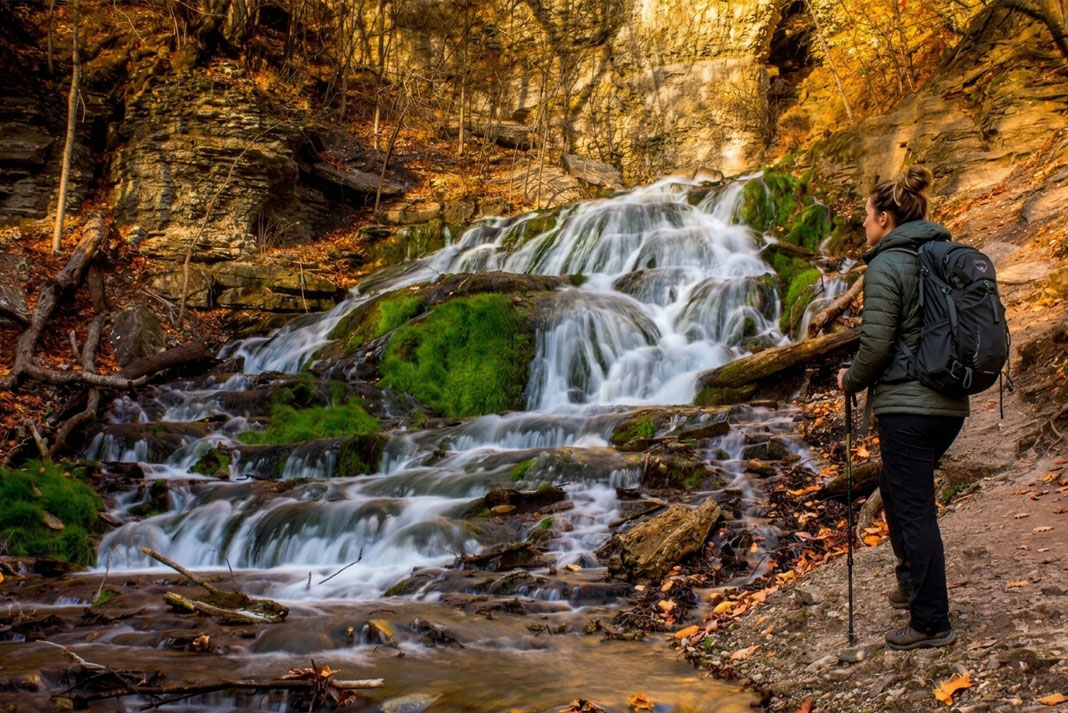

Start at Dunning’s Spring Park, on the north edge of town, and don’t rush it. A waterfall drops over a limestone ledge into a shallow pool, surrounded by trails climbing through the sugar maples and bur oaks. Just down the road along the bluff sits the old Ice Cave, a talus cave in the hillside known for breathing cold air out of its mouth even on warm days. In October, the whole north-side bluff loop takes under an hour to explore. It costs nothing and there’s rarely a line for the view.
What you’ll find when you get there is quieter than the photos suggest. The parking area is small, the trail surface is dirt and limestone gravel rather than pavement, and the cave itself is more crevice than cavern — you look in, you don’t walk through. That’s fine. The point isn’t the cave. It’s the bluff above it, the creek below it, and the fact that almost nobody else from outside Winneshiek County seems to know it’s there.
Downtown and the Museum on Water Street
Decorah’s Water Street is the reason people use words like “walkable” without meaning to sound like a real estate listing. It’s a few blocks of storefronts in century-old brick buildings, and most of what’s inside is locally owned — a bookstore, a bakery, a couple of gear shops that outfit the trout crowd. The Vesterheim Norwegian-American Museum anchors the north end of the strip, and it’s the largest museum in the country dedicated to a single immigrant group. Folk art, immigrant-era buildings moved onto the property, a rotating textile collection. If you want the longer version of why this part of Iowa looks and sounds the way it does, the State Historical Society of Iowa keeps archival material on the region’s Norwegian settlement patterns going back to the 1850s.
When to Go, and Why the Calendar Matters Here
Color peaks in this stretch of the Driftless Area in the first half of October, sometimes stretching into the third week depending on frost timing. The bluffs hold hardwoods rather than prairie, so the display runs longer and deeper red than most of the state — oak holds its color into late October after the maples have already dropped.
One thing to check before you book a room: Luther College sits right in town, and its homecoming weekend, typically in early-to-mid October, fills every bed for miles. If you’re not there for the football game, pick a different weekend or plan on driving in from Waukon or Postville. Travel Iowa posts a statewide fall color tracker each season, which is a better source than guessing from last year’s dates.
Seed Savers, Spillville, and the Water in Between
A few miles north of town on Highway 9, Seed Savers Exchange runs Heritage Farm, an orchard and seed-preservation operation open to visitors. Fall is apple season there, with old varieties you won’t find in a grocery store, and the display gardens are still going before the first hard frost.
South on Highway 52, about twenty minutes out, is Spillville — a town of a few hundred people best known for the Bily Clocks Museum and the house where Antonín Dvořák spent a summer in 1893 working on the “American” String Quartet. It’s an odd, specific footnote for a farm town this size, and worth the detour if you’re already headed that direction.
Then there’s the water. Trout Run flows right through Decorah, and a paved trail loops alongside it for close to eleven miles, easy for a bike or a stroller. Winneshiek County has some of the best spring-fed trout streams in the Midwest, cold enough year-round to support trout that can’t survive in most Iowa creeks. Fall fishing here runs quieter than the crowded opening weeks of spring, with lower water and fewer boots in the creek. Check current regulations and any stocking updates through the Iowa.gov portal before you go — limits and seasons shift, and it’s the kind of detail not worth guessing on.
The One Thing People Get Wrong
Decorah leans hard into its Norwegian identity, in the museum signage, the storefronts, the flags. That leads a lot of first-time visitors to assume Nordic Fest — the town’s big Norwegian heritage festival, with food vendors and folk dancing filling the streets — happens sometime in fall. It doesn’t. It’s held in late July. Show up in October expecting a festival atmosphere and you’ll just find a regular, pleasant small town going about its business, which honestly might be the better version anyway. Fewer crowds, more parking, and the bluffs are on fire either way.