
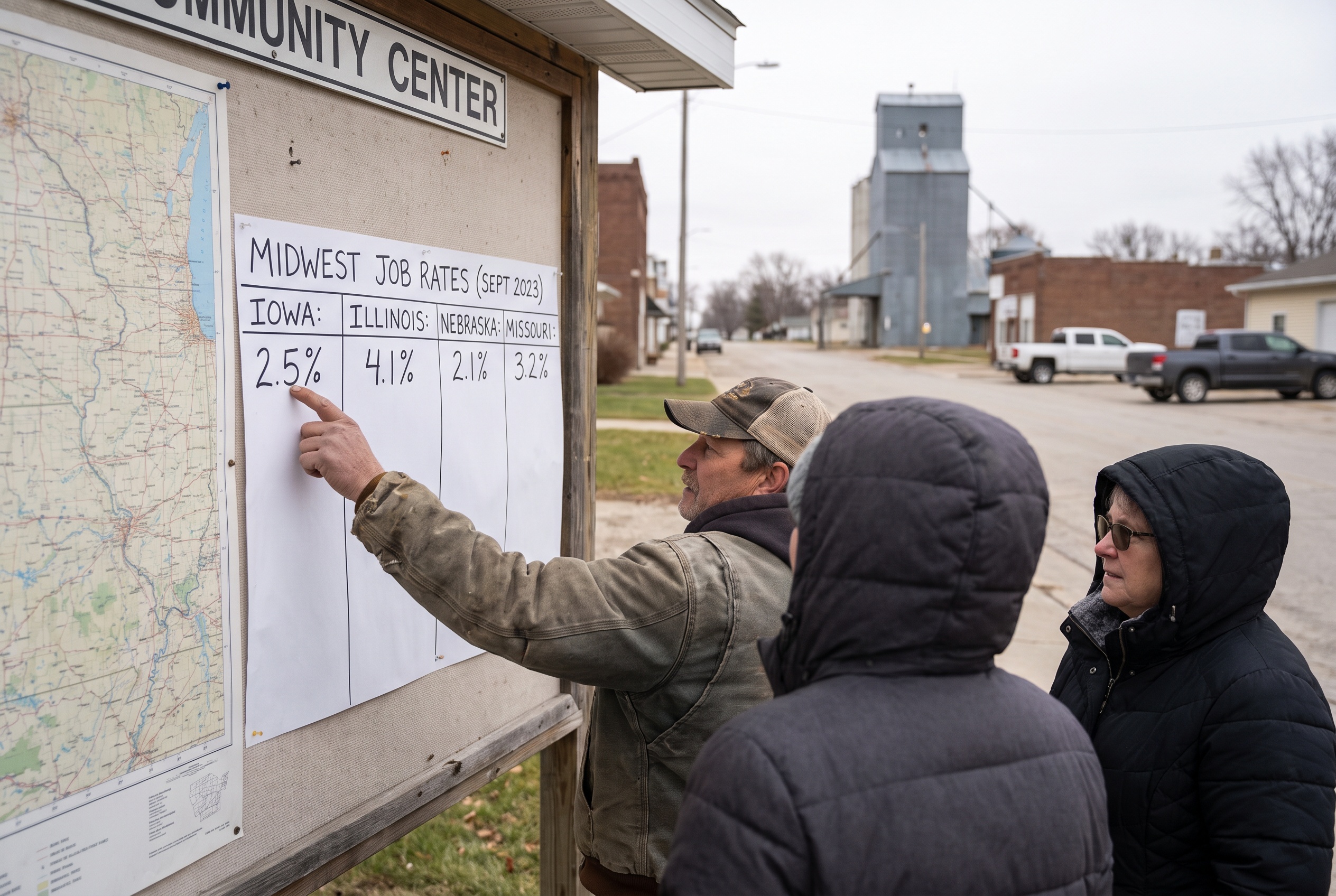

Iowa borders six states, and its labor market gets measured against all of them, month after month, by the same federal survey that tracks the nation’s jobless numbers. The comparison is a familiar one in Statehouse debates and county economic development pitches alike. It’s also more complicated than a single ranking suggests.
The U.S. Bureau of Labor Statistics publishes monthly unemployment estimates for every state, and Iowa Workforce Development republishes and interprets that data for Iowa specifically, including breakdowns by county and metro area. Illinois, Wisconsin, Minnesota, South Dakota, Nebraska and Missouri each have a counterpart agency that does the same for their own residents. None of these figures are static. They get revised, seasonally adjusted, and sometimes corrected weeks after initial release.
A Regional Pattern, Not a Fixed Rank
Iowa’s rate has, in recent years, tended to sit in the same general range as its neighbors rather than standing out sharply higher or lower. Economists who study the Midwest often point to shared industries — agriculture, manufacturing, food processing — as one reason bordering states move together rather than diverging. When a meatpacking plant slows production in northeast Iowa, the effect can show up in employment numbers on both sides of the Mississippi.
That said, month-to-month rankings shift. A state can move from near the bottom of the regional pack to the middle within a single reporting cycle, often because of a single large employer’s hiring decision or a seasonal industry’s calendar. Readers looking for the current month’s exact figures, for Iowa or any neighboring state, should check the agency reports directly rather than rely on a comparison that may already be out of date by publication.
Why the Numbers Move
Unemployment rates are not simple headcounts. They reflect a survey-based estimate of people actively looking for work as a share of the labor force, and that labor force itself changes as people retire, move, or stop looking altogether. A rate can fall not because more people found jobs, but because fewer people are counted as looking.
The Iowa Economic Development Authority uses this same underlying data, along with separate measures like job openings and wage growth, when it evaluates whether a region qualifies for state incentive programs. A county with a low unemployment rate but stagnant wages tells a different story than one with a higher rate and strong hiring demand. The comparison between Iowa and its neighbors works the same way — a single number rarely captures what’s happening underneath it.
For readers who want the actual current figures, both statewide and by county, Iowa.gov links to the state agencies responsible for publishing them. Neighboring states maintain their own equivalent pages. None of those numbers belong in a magazine article months after they’re printed. They belong on the agency site, updated on schedule, current the day you look.