
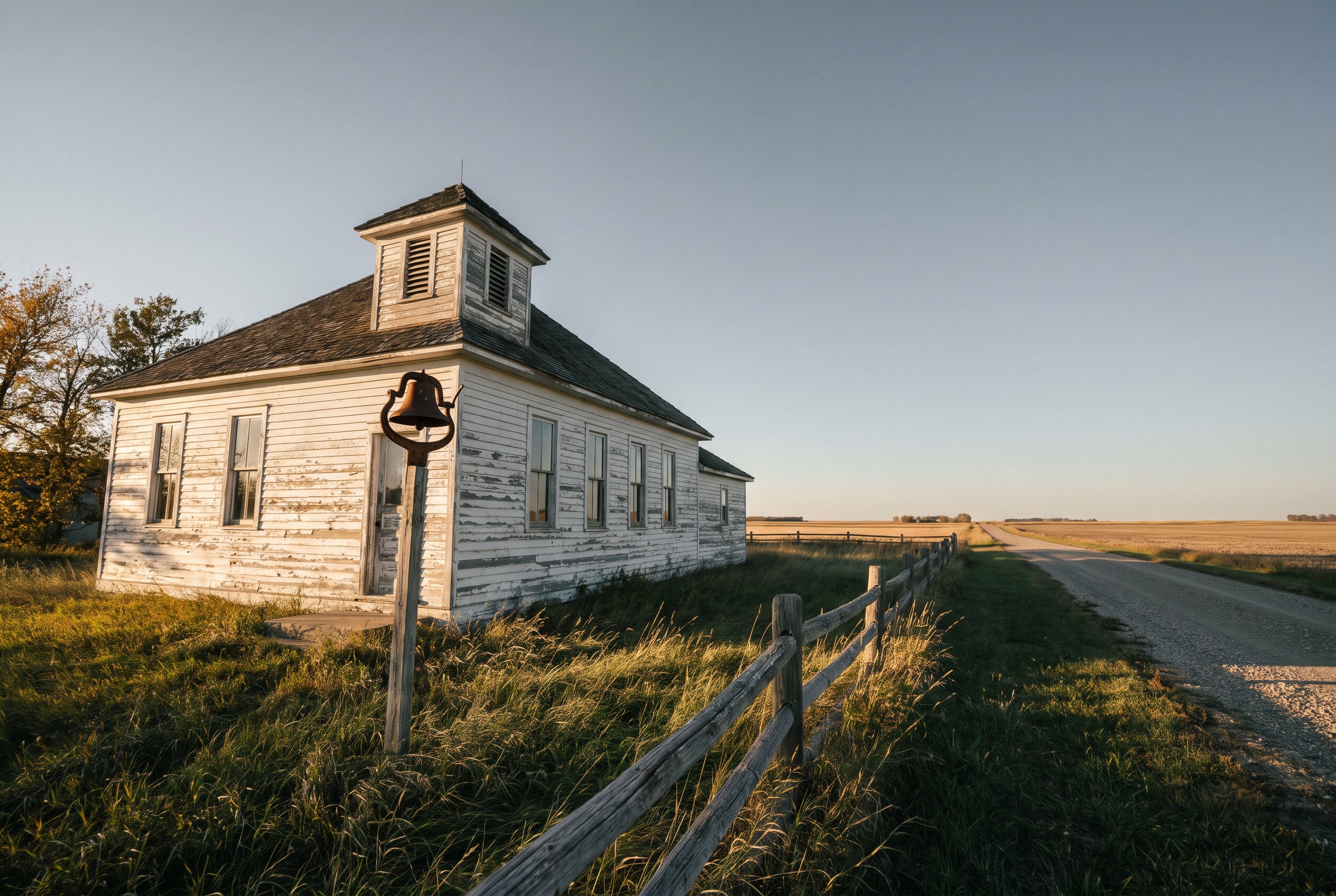

Start at the Herbert Hoover National Historic Site in West Branch, just off Interstate 80 between Iowa City and Davenport. The schoolhouse there is small enough that you could walk its full length in nine steps, and that’s the point. Built in 1853, it’s the oldest structure in town—a restored one-room building where Hoover’s family members sat as students, and where local tradition says a young Bertie Hoover learned his early lessons alongside classmates of all ages, gathered around a single woodstove to beat an Iowa winter.
What you’ll find when you get there
The building is plain on purpose. Board-and-batten siding, a bell you can still ring, rows of desks bolted to the floor in descending size from back to front, because the youngest sat up close and the oldest in back could mostly be trusted to work alone. There’s a recitation bench where students came forward in age groups to read aloud while the rest of the room worked at their seats. No hallways, no gym, no principal’s office. Just one room, one teacher, and whatever the township could afford that year.
That last part mattered more than people remember. Iowa’s one-room schools weren’t run by the state. They were run by township school boards, funded by local property tax, staffed by young women — often teenagers themselves — who boarded with a farm family for the term and moved on when the contract ended. The schools were spaced so no child had to walk more than a couple of miles, which meant nearly every section of surveyed farmland in the state had one within sight of a fence line at some point in the late 1800s and early 1900s.
When to go, and why the calendar matters here
The Hoover site runs on National Park Service seasonal hours, and the schoolhouse interior isn’t always staffed or open the same way in January as it is in July, so check current hours before you drive out — especially in winter, when the visitor center scales back. Early fall is a good window. The Hoover gravesite and prairie plantings nearby are at their best with a little color in the grass, and the crowds thin out once the Hoover birthday events in August wrap up.
If you’re the kind of traveler who likes context before artifact, the State Historical Society of Iowa keeps records on the consolidation era that emptied most of these buildings out. That push started gaining real momentum after World War II, as gravel roads improved, school buses became standard, and township boards realized they couldn’t offer the same science labs and music programs a nine-room school in a larger town could. By the 1960s, most of Iowa’s rural districts had merged into consolidated systems, and the one-room buildings were sold off, moved onto farms as machine sheds, or simply left to the weather.
What else is nearby
West Branch sits close enough to the Amana Colonies that you could make a full day of it — communal-era buildings on one end, single-room frontier education on the other. Iowa City is fifteen minutes west if you want a meal and a bookstore before heading home. And if you drive south instead, toward Kalona in Washington County or further down toward Bloomfield in Davis County, you’ll pass working Amish and Old Order Mennonite schools that still operate exactly the way the Hoover building once did — one teacher, one room, all grades together. Those aren’t museums. They’re in session.
The thing most people get wrong
Visitors assume the one-room school is purely a historical artifact, something Iowa used to do and grew out of. It isn’t. There are still working one-room schools in the state today, mostly serving Amish and Plain communities in the eastern and southeastern counties, and they’re private schools on private land. Don’t treat them like roadside attractions. If you’re driving through Washington or Davis County and pass a small white building with a group of kids at recess, slow down, sure — but keep moving. That’s somebody’s classroom, not a photo op. The Travel Iowa office can point you toward the preserved and publicly accessible schoolhouses around the state if you want more than one stop on the itinerary; there are several tucked into county fairgrounds and historical village sites that welcome visitors on a regular schedule, unlike the ones still doing what they were built to do.