
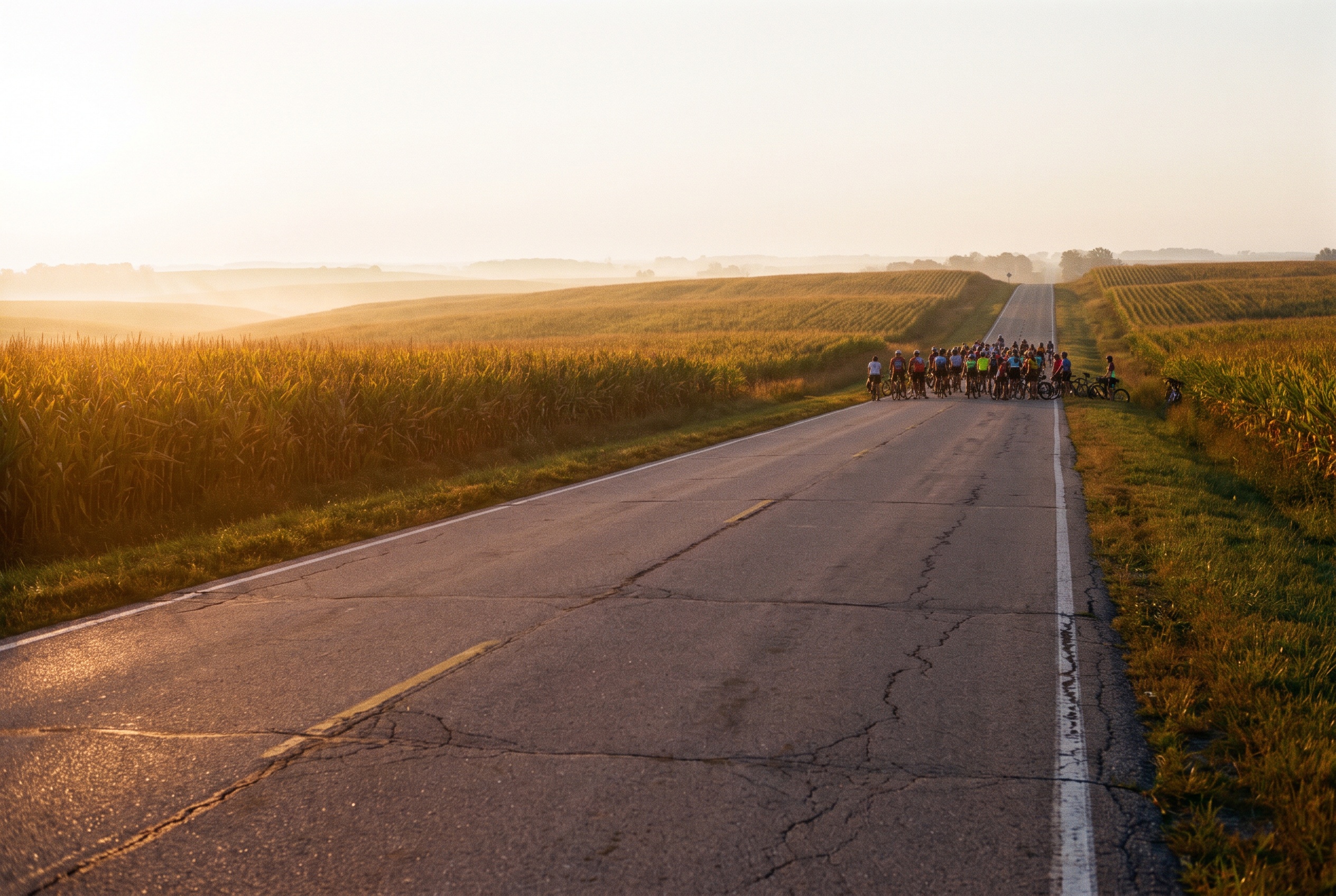

Stand on Main Street in almost any small Iowa town on the right week in July and you’ll see something that looks like a parade got lost and multiplied. Thousands of bicycles, riders in every kind of gear from serious spandex to full costume, rolling through in a loose river that takes an hour to pass. That’s RAGBRAI, and you don’t need to own a bike or ride a mile of it to understand why people plan their whole summer around being in one of these towns when it happens.
What RAGBRAI Actually Is
RAGBRAI stands for the Register’s Annual Great Bicycle Ride Across Iowa. It started in 1973 as a stunt dreamed up by two Des Moines Register writers, John Karras and Donald Kaul, who figured a bike ride across the state would make a good column. Roughly 300 people showed up that first year. It has grown into the largest and oldest touring bicycle ride in the world, drawing tens of thousands of riders for at least part of the week. The State Historical Society of Iowa has documented its growth from newspaper gimmick to statewide institution, which tells you something about how deep this has rooted.
It is not a race. There’s no clock, no finish line with a winner, no prize purse. Riders dip a back tire in the Missouri River on the west side of the state and, seven days and a few hundred miles later, dip the front tire in the Mississippi on the east side. In between, they eat a lot of pie.
The Route Changes On Purpose
Here’s the part people from outside Iowa never quite get: the route is different every single year. It always starts somewhere along the western border and ends somewhere along the eastern border, but which towns fall in between, how far north or south the line runs, which river towns get the honor of hosting overnight crowds — none of that repeats from one year to the next.
Towns apply to host an overnight stop, and being chosen is a genuinely big deal economically and socially for a town of a few thousand people. A town that hosted in 2019 might not host again for a decade, if ever. The organizers rotate the path partly out of fairness and partly because the whole appeal depends on riders seeing new stretches of the state instead of the same gravel and blacktop every July. A rider who’s done the ride a dozen times will tell you no two years look alike, and that’s not marketing, that’s just how the route committee draws the map each winter.
When to Go, and Why the Timing Matters
RAGBRAI runs during the last full week of July, though the exact days can shift slightly year to year, so it’s worth checking current details through Travel Iowa or the ride’s own announcements before you plan anything around it. Late July matters for a practical reason beyond tradition: it’s deep enough into summer that county roads are dry and mostly settled, corn is tall and green on either side of the highway, and small towns have their festival infrastructure — food booths, portable toilets, parking arrangements — already worked out from a lifetime of county fairs. Go earlier in summer and you’re fighting spring mud and unpredictable weather. Go into August and you’re bumping into harvest prep season for a lot of these same towns.
If you’re not riding but want to experience an overnight town, aim to arrive the evening before the riders do, when the town is setting up but not yet overwhelmed. The morning after, watching a town wake up and slowly load a few thousand cyclists back onto the road, is its own kind of spectacle, quieter than the arrival but worth the early start.
What Else Is Nearby
Because the route changes, “nearby” changes too, which is part of the fun of following it as a spectator rather than a rider. One year it might route riders through the Loess Hills in the west. Another year it tracks along the Mississippi bluffs in the east, or cuts through the flat, wide farm country of central Iowa where the horizon doesn’t interrupt itself for miles. Whatever the route, overnight towns typically turn their downtown into a temporary festival: church basements selling pie and pork tenderloins, high school band boosters running concession stands, local breweries and civic groups setting up beer gardens that fund the volunteer fire department for another year. Pass-through towns, the ones riders move through midday rather than sleep in, often put on a smaller version of the same thing for an hour or two. If you’re road-tripping to catch a glimpse, build in time to actually stop rather than just watch from the car.
The Thing Most People Get Wrong
Newcomers assume they can just show up on the day of and drive straight through a host town like any other Tuesday. They can’t, not easily. Host towns frequently close or reroute sections of highway for hours around the peak arrival window, and parking anywhere near downtown fills early with rider vehicles, support crews, and other spectators who had the same idea. If you’re planning to be a bystander rather than a participant, treat it like you would a county fair or a parade day: park on the edge of town, walk in, and expect the main road through to be a pedestrian and bicycle space for a stretch of the afternoon. Riders also need proper credentials to be on the route at all, whether that’s a full-week registration or a single-day pass, and specifics on how to register change enough from year to year that it’s worth checking directly with the ride’s organizers or a resource like Iowa.gov rather than assuming last year’s rules still apply.